Grey Screen: something to read while you respawn. League, counted on.
Bureau of Rift Statistics · Report No. 1 · The grey screen
This is Report No. 1 (22 Oct 2026). The newest report is Report No. 2, the patch notes.
League's "unkillable" champion spends as long dead as anyone else. I counted 30,510 games to find out why.
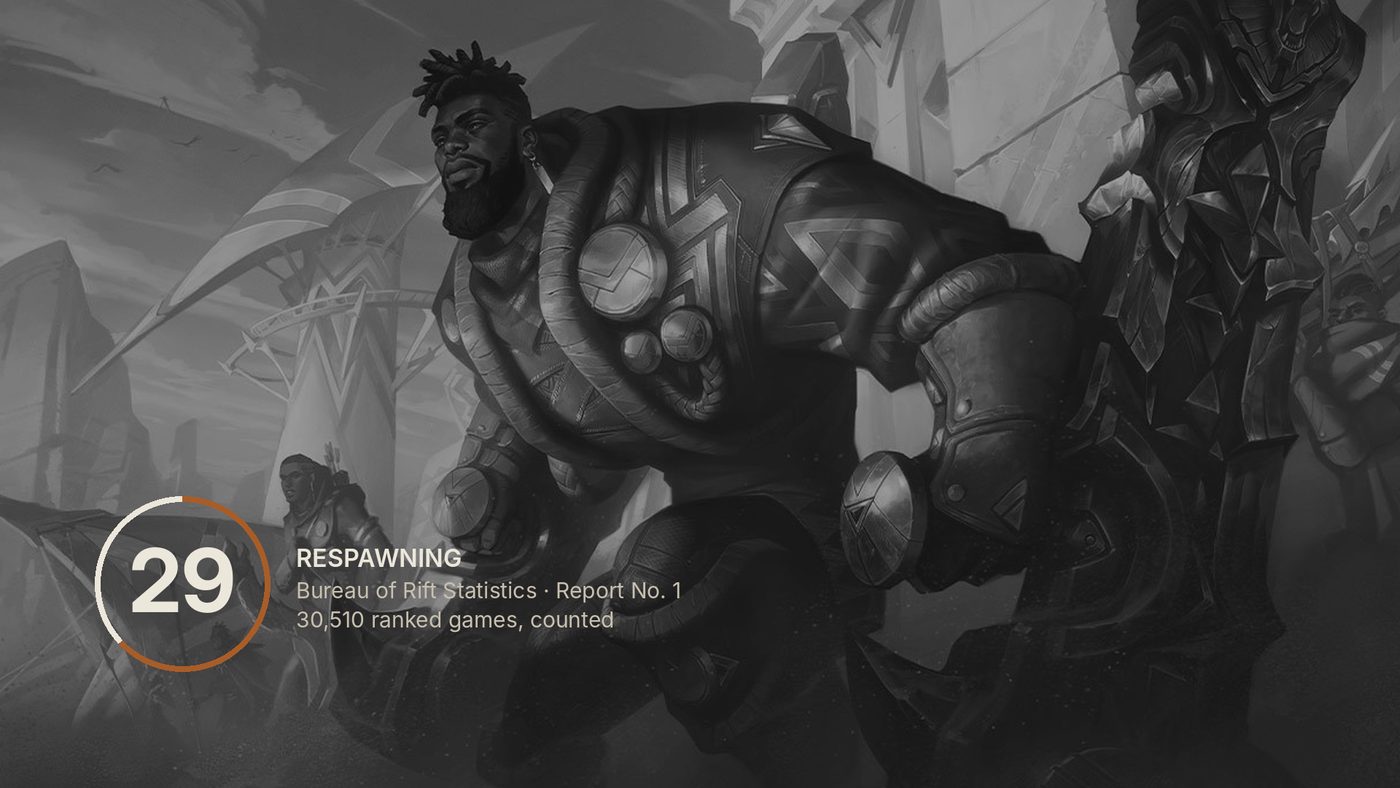
“K’Sante is unkillable.” No. Champions with more escape tools spend more time dead, at every rank. K’Sante, in Master to Challenger: 10 minutes of every 100 dead (between 9 and 11); the average tank there, about 9.
224 games from 92 players · from a census of 30,510 NA ranked games, 29 Sep to 15 Oct 2026
Near surface
Bureau of Rift Statistics · Report No. 1 · The grey screen NA ranked solo queue, games played 29 September to 15 October 2026, patches 26.19 and 26.20 · 30,510 games from 7,717 players drawn at random, Iron to Challenger · every headline number shows its margin of error
The question: K'Sante has four escape tools, tied for the most in the game, and players call him unkillable. Do escape tools (dashes, blinks, untargetability, revives) keep champions alive? The short answer: no. Champions with more of them spend more time dead at every rank, and they die deeper in enemy territory. Escape tools, it turns out, are more likely engage tools, K'Sante's included. Getting better cuts what they cost about in half, but the cost never disappears.
Crust
Ever been to the old Summoner's Rift? Some would call it timeless, and I'm some. I started playing League in 2013, on the blurry Rift seen from above at an angle, where two champions met in a lane and threw hands until one of them fell over. My hands shook every time damn near, from whatever, hormones, anger, coursing defeat through a tween body. When my champion went down, the screen went grey, a countdown started, and I watched my team play four against five until I came back. It felt like hockey's penalty box: the same itch to get back out there, only this time I was the one in the box, and my own mistake had put me there. Riot built that feeling into a MOBA, a multiplayer online battle arena, and I still love it.
Worlds is under way! And every year I hear analysts grumble about death timers, or about how rarely the pros seem to see one. On a stage with a title at stake, thirty seconds on the grey screen can cost a team a dragon (one of the big monsters both teams fight over), a tower or the game.
League of Legends is two teams of five on one map, Summoner's Rift, each trying to destroy the other's base. Every player picks a champion, a character with a handful of abilities called a kit. When a champion dies, its portrait goes grey and its player waits out a respawn timer, which gets longer as the champion levels up and increases still later in the game. At Worlds the pros rarely die and hardly seem to wait at all. I find that impressive. Five people timing their micro-mouse-movements so precisely that nobody gets caught alone. It's nerdy, but that coordination is exactly why millions of fans tune in, and why I'll be in the crowd for the semifinals in Allen, Texas, this November. I am, to put it mildly, jammed.
You may have noticed I said 2013. I'm an old head, at least in my game knowledge, though I try my best to keep up with the esports scene through Caedrel, a former pro turned streamer. I stopped keeping up with patch notes after K'Sante; his ultimate, All Out, is too much (c'mon y'all -- untargetable!?? Vanish frames?? It broke my adolescent brain). The champions Riot has released since are feats of design, and I get excited every time a pro finds an outplay in a kit I barely understand. So much dashing. Like a figure skater on fire. I've since dropped playing Ranked myself. I moved my focus to Teamfight Tactics. At 173 champions, with many of them defying logic to my tired eyes (like, so much dashing), keeping up with League's patch notes started to feel like a second job, and when I quit Ranked (a story in my last article), I let that job go.
Crust
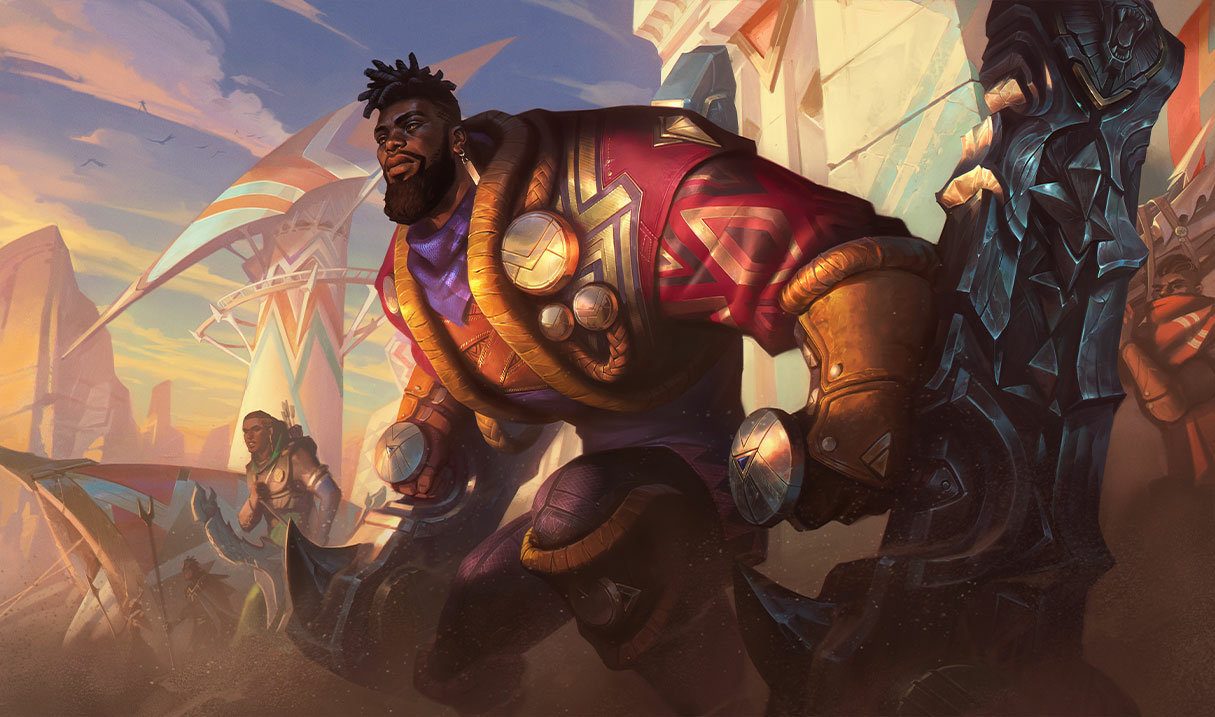
And K'Sante. Here's the K'Sante that lives in my head, rent-free, courtesy of the man who keeps me current:
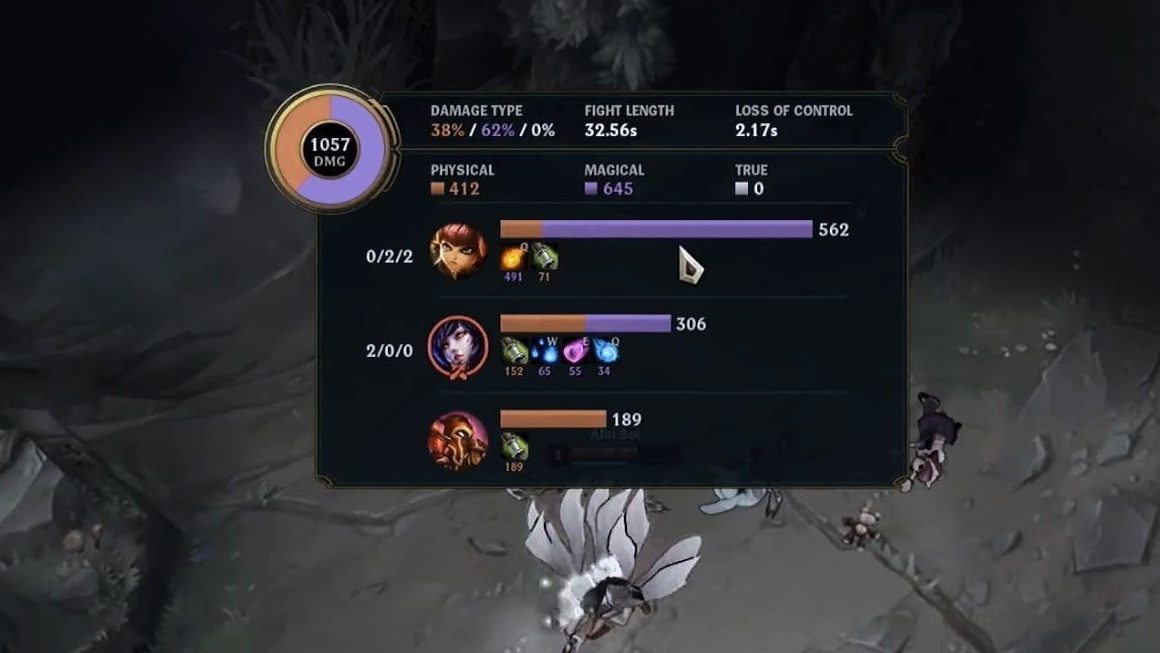
I'm not alone. On r/leagueoflegends, one netizen put the case plainly: his kit is so overloaded that "he has an answer for every situation." Yup: a tank, the role built to soak up damage, who Soulja Boys in, dashes out, and bare knuckles home. Absurd. Here's what a K'Sante feels like doing it:
So K'Sante is my first suspect. If any champion should be seeing the grey screen less than any other, it's him. I'll come back to him.
In 2015 Kotaku covered players calling a brand-new champion, Ekko, overloaded and maybe that was the beginning of the swing in public opinion on mobility in kits. In May 2021 a Riot designer, Riot Scruffy, wrote that mobility had crept too high and promised a college try to trim it. About a month later, patch 11.13 cut movement speed from ten items and a rune and took the dash off Stridebreaker, an item; that dash never came back. Champions' own dashes, the ones this census counts, came through untouched. This July Riot opened League Classic, a rebuilt Season 3 with the old map and the old kits. Somebody at Riot misses 2013 too, it seems, and the old heads, me included, couldn't be more soothed.
I love the new champions all the same, invulnerability frames be damned. And players are getting better, so it makes sense that designers want to keep their attention. Dashes are flashy, after all, and risky. But rewarding. A game played since 2009 needs harder things to master, or its best players drift away (the ones who feed into the ultra-lucrative LoL Esports pipeline, not us regulars, or even local Challengers). When I do play, I'm a faithful Zilean support, the role that keeps teammates alive instead of chasing kills. I'm a chiller, y'all. Jenova Chen, who wrote his thesis on flow before he made Journey, says players reach that state where time disappears at different levels of challenge, and mine is pretty low. An increasingly long roster lets one game keep both the beginner and the expert in that channel, hypothetically forever, catering to both strivers at different levels. Balance is the catch, hence rolling patch notes.
So I ask the census one question. Do all these dashes keep champions off the grey screen as much as the pros make it seem to normie eyes like mine?
Mantle
How I counted
I ran this like a pollster. A pollster can't call every voter, so they call a few thousand at random, and they call extra people in small states so those states have enough answers to balance out the mismatch in count. I couldn't watch every ranked game in North America, so I pulled players at random from Riot's own ranked ladder, ten tiers from Iron at the bottom to Challenger at the top, using the Riot API and Claude as production support. Most accounts on the ladder hadn't played ranked in the two weeks before I drew them (in Bronze, about three in four), so I kept drawing until each tier had enough players who had. I took about 1,000 from each tier from Iron to Diamond, and 250 from each of Master, Grandmaster and Challenger, the small states of the ladder. Then I took up to five of each player's ranked games from the two weeks before I drew them.
That came to 30,510 games. So end to end, that's about 15,000 hours of League, a year and eight months of play if nobody ever slept. Within those games, champions died nearly two million times.
Then I weighted the games, because my sample has two lopsided parts. First, the tiers: Gold has far more players than Challenger, but I drew a similar number from each, so every Gold player I drew stands in for many more real players than a Challenger does. Second, the players: I took five games from everyone, but one Gold player might have queued twenty ranked games those two weeks and another only five. Counted flat, the casual player's games would count as much as the grinder's. So each of the grinder's five games counts four times, standing in for the twenty they played, and each of the casual player's counts once. I capped it at twenty so one marathon account can't swing a tier, and none of this touches champion level or rank inside a tier; it only makes my 30,510 games add up the way the real ladder plays out.
Before I looked at a single result, I wrote the rules down: what counts, what doesn't, and what would count as a finding. A referee officiating, with strict guidelines.
The quant is simple. Out of every 100 minutes a champion is played, how many does it spend dead? I counted time instead of deaths because the Rift charges by the minute. Two things set the price of a death. Your champion's level sets the base: 10 seconds at level 1, climbing to 52.5 seconds at level 18. Then, from the 15-minute mark, the game clock adds a surcharge on top. It's about 13% by 30 minutes and 22% by 45, then climbs fast to a cap of 50% by 55 minutes. So the most a death can cost is a level-18 champion dying in a 55-minute game: 52.5 seconds plus half again, 78.75 seconds. Pyke, a support who dives in early and often, dies about three times for every ten minutes he's alive, but each death costs him 24 to 27 seconds. Illaoi, a slow priestess with tentacles, dies less often and pays 33 to 37 seconds every time. Count deaths alone and Pyke looks reckless. Count seconds and you see each of his deaths costs about a quarter less than hers.
Every "give or take" in this piece comes from rerunning the whole census 2,000 times on reshuffled copies of the sample and watching how far the answer moved. The range I give is where the answer fell in 95 of every 100 reruns.
I counted NA solo queue. The top three tiers, Master to Challenger, stand in for the stage, the closest the ladder gets to the players on it (yes, Faker, the most decorated player in the game, plays in Korea; this is my region, and I'm loyal to it against my better judgment).
Outer core
What the census found
I found champions spend about a ninth of every game on the grey screen. The average game ran about 30 minutes. In Iron, the lowest tier, a champion dies about 7 times in that half hour and waits about 31 seconds each time: 3.5 minutes grey (give or take 0.04). In the top tiers it's about 6 deaths at 29 seconds each: 3.0 minutes (give or take 0.05). That half-minute added is about one respawn timer per game. Better players die less. Their games also run shorter, about 28 minutes at the top against 30 from Iron to Gold, and shorter games mean cheaper deaths, so I adjusted for game length. Most of the difference remained.
Then I turned to the dashes. I counted every escape tool in all 173 kits, from Riot's own ability text, checked against the community wiki's lists and then by hand: dashes, leaps, blinks, untargetability, stasis and revives. Champions with more of them spend more time on the grey screen, in every tier. Mind blown! That was the test I really wanted to solve before I looked at the graphs, and it came out the same way in eight tiers out of eight. Then I put a price on it. Call it the dash tax. When I compared like with like, assassins (built to kill fast) with assassins and tanks with tanks, each extra escape tool costs about 7 seconds per 30-minute game in Iron (between 6 and 9). Here's how to see it. In Iron, one death costs about 31 seconds of grey screen. So each escape tool in a kit adds about a quarter of a death to every game that champion plays. Two tools, half a death. Four tools, like K'Sante or Aurora, and it's nearly as if the champion dies one extra time every single game, compared with a champion that has none. Skill issue? Speaking from experience, yes.
There's an easy way to wave all that away: maybe it's the players, not the champions. The kind of person who loves diving picks dash champions, and that person would die just as much on Garen. So I watched the same people play different champions. 1,854 players in my sample played at least one champion with no escape tools and at least one with two or more: same hands, same habits, different kits. On the dash-heavy picks they spent about 12 more seconds dead per 30-minute game (between 7 and 17). At roughly 30 seconds a death, that's about two extra deaths every five games, for the same person, just from changing champions. Then I split the difference in two. About three-fifths of it stayed when each player was compared with themselves; that part belongs to the champions. The other two-fifths came from who chooses dash champions in the first place; that part belongs to the players. So the players explain some of the dash tax, and the champions explain most of it.
So where do the dash champions die? I split the map down the middle at the river: your half has your towers and your base, the enemy's half has theirs. For champions with no escape tools, about 7 of every 20 deaths happen on the enemy's half (36%). With one tool, about 8 (42%). With two or more, about 9 (45%). I also checked when the deaths happen, early, mid or late game, in case dash champions simply die at a different stage of the game. They don't; the three groups match. The difference is where. Dash champions die deeper in enemy territory, farther from their own towers. The dash gets them in. Getting home... that's the skill cap.
Inner core
I went back to Scruffy's note. Riot wanted mobility to reward risk and the choice of when to fight, never to let a champion always pick its moment. Read that way, the census and Riot agree: a dash is a tool for starting a fight on the other team's turf, and fights there end with the dasher grey more often. I've been calling these escape tools this whole piece. The map says they're engage tools. Which might explain why I always ended up on support, and I was never good at Alistar (I am avoidant by nature :)).
And I watched the dash tax fall with skill. In Iron, each extra tool costs about 7 seconds. From Platinum to Diamond, about 3; at the very top, about 4. In practiced hands the dash costs about half as much: a learner on stick who stalls vs a seasoned racer who saves time with the same tools. What you see on stage is the cheapest end of that curve. I played, and you likely do too, at the expensive end. That matters, because the dash tax is steepest exactly where people are still learning. George Skaff Elias, Richard Garfield and K. Robert Gutschera warned about this in 2012. In their book on how games work, they wrote that some games make weaker players sit out far more of each match, which punishes beginners and slows how fast they improve, and the example they named was DotA, the game League grew out of. A new player on a three-dash champion pays the most time on the grey screen, and time on the grey screen is time not spent playing, which is time not spent getting better. Lower tiers do lean a little toward the tax-free kits: in Iron, about 41% of play time goes to champions with no escape tools, against 34% in Master and up. Whether that's players learning the price or dash kits simply being harder to pick up, my data can't say.
Mantle, far side
The old sluggers never left
I found nineteen champions with kits from 2013 or earlier still played in every tier, from Iron to Challenger. Eight of them have no escape tool at all: Ashe, Blitzcrank, Cho'Gath, Garen, Jinx, Lux, Nami and Xerath. Garen, a soldier with a big sword and a spin (in the game since April 2010), spends about 11 minutes of every 100 dead, right in the middle of the pack. That's the point of Garen. Zero escape tools, and he dies no more than the average champion. He pays no dash tax at all, and sixteen years on, people at every rank still play him.
Frank Lantz, in The Beauty of Games, uses League to split skill from knowledge. Timing, aim and movement are skill, tied to mechanics. The dynamic encyclopedia of facts about what every champion can do is knowledge, and is tied to game sense, builds, routing, etc. I think that's what the nostalgia is about, with these new-fangled dashes. Old League asked you to know less, react less, chill with your friends, maybe flash a wall or an ability and that was the outplay of the match. Now, every new dash and escape is a chance at skill-portrayal, showing off for the crowd (aura-farming, I still got it), for the player who owns it, and patch notes homework for the nine who don't. Alas, such is the fun we subject ourselves to, unabashed in our masochism. Rah!
So, K'Sante. My first suspect, the subject of the clip up top. Only the top tiers play him enough to judge: 224 games from 92 players in Master to Challenger. There he spends about 10 minutes of every 100 dead (between 9 and 11). Given how long his games ran, a typical champion in those same games would spend about 10.3. The average tank up there spends about 9. So the unkillable tank dies right on par with everyone else, and if anything a touch more than the other tanks, though that difference is within the margin. I had him down as unkillable too... Here's how I square it with the clip. K'Sante has four escape tools; only one other champion in the game, Aurora, has that many. And the map tells you what four tools buy: he gets in, deep, every time. The highlight reel shows the power of the ol' engage n' 'scape. Nobody clips the K'Sante who dashed in and died.
And the champion least often on the grey screen, in seven of the eight tiers, is Yuumi, the cat who rides on a teammate's head, the inevitable (you should REALLY see my last article): 5 to 6 minutes of every 100 (at the very top, Milio, another enchanter support, edges her out). Too few people play either for me to formally rank them. That one stings. My own Zilean, whose ultimate brings a champion back from death, spends about 7 to 9 minutes of every 100 on the grey screen in every tier. Too few people play him for me to rank him, which suits me (and my individuality complex) just fine.
The netizens v. K'Sante: friends of the court, in brief. The Bureau doesn't rule on feelings, but it reads the briefs.
For the prosecution, 2024. A K'Sante player asked r/leagueoflegends what everyone's problem was, and the netizens answered nearly as one: the kit has everything. One sorted every champion's tools into four kinds, mobility, crowd control, damage and survivability, and argued that most champions get two or three while K'Sante gets all four. Another called him "a jack of all trades, master of all of them." The thread's most upvoted reply was the copypasta credited to the pro player ShowMaker, which lists his health, his armor and every button in his kit before dissolving into a scream. The netizen who said he has an answer for every situation added a caveat: "in average play he is nowhere near that strong."
In between. By my count of the community wiki's patch history, 32 patches have touched him since he arrived in patch 12.21: six net nerfs, six buffs, six mixed, the rest fixes. Two were overhauls: All Out in patch 13.20, and a gameplay update in 14.19 that rebuilt nearly every ability. The latest nerf came in patch 26.20, in the middle of my census.
For the defense, 2026. On r/KSanteMains, his players are in mourning. One thread is titled "I'm really very sad about what they're doing to K'Sante." Its top reply says that "in this meta he dies very fast compared to other tanks."
The Bureau's finding. The mains are closer to the truth than the prosecution. In Master to Challenger he spends about 10 minutes of every 100 dead; the average tank there spends about 9. Whatever he was in 2023, the K'Sante in this census is a regular tank, and his past reputation precedes him.
Crust, far side
Why do they fight at all?
Riot's lore once gave the Rift a story. In the old version, summoners ruled Runeterra from an Institute of War, and the big political questions of the continent were settled by matches on the Fields of Justice. You, the player, were the summoner, and the Rift was a courtroom with fireballs. That's why they fought. In September 2014 Riot retired all of it, saying it made champions little more than puppets of godlike summoners. Runeterra itself has more story than ever, from Riot's short stories to Arcane on Netflix. What the Rift lost was a reason. The champions still meet there; nobody says why. The champion kits still come from somewhere, though, and their homelands speak some to what they can do. I tagged every champion with its home region from Riot's own site and counted again. Ionia, an island chain where spirits criss-cross archipelagos, came out with the most movement tools per champion, by a hair. The Shadow Isles, cursed islands where the dead don't stay down, have the most ways to turn untargetable, the closest a kit gets to cheating death. And once I accounted for the kind of champion, the most time on the grey screen, in six of the eight tiers, belongs to Bilgewater, a port city of smugglers and serpent hunters, slippery and slight, home to Pyke and Illaoi.
That left me with a question for anyone who makes games. When the story can justify anything, how do you know a kit has enough? Anna Anthropy and Naomi Clark, in A Game Design Vocabulary, call each thing a player can do a verb. Every new rule takes attention from the ones already there, and a verb tied to nothing else in the kit is an orphan, however well the lore explains it. Elias and his co-authors say successful games tend to have one or two real innovations. Garen has a sword and a spin, and sixteen years later he's still in every tier.
So I'll put the question to you. Should champions be easy to learn and hard to master, the line usually credited to Atari's Nolan Bushnell? League's newest kits are hard to master in a way you can now put a number on: they cost seconds until you're good. Is that the tax we aspire for in pursuit of one-trick mastery, playing one champion forever? I want to hear from people who design kits, and from anyone who mained Sword-Captain of the Dauntless Vanguard (lmao, did yall know this was his title!? sick), Garen, in 2013.
Far surface
What to watch this weekend
My numbers come from solo queue, not the stage, so treat these as tests you can run from your couch, and cite when your friend asks why you're yelling.
- Every time someone dies, check the minimap. Was it on their side of the river or the enemy's? In my census, champions with two or more escape tools die on the enemy's half 45% of the time, against 36% for champions with none. A dash champion going grey past the river is the dash tax being collected, live.
- If K'Sante is drafted, wait for All Out. When he knocks someone over a wall and dashes in after them, count until he's either back with his team or grey.
- Watch the timer, not just the kill. Late in a long game, one death costs a minute or more, up to 78.75 seconds. That's when one dash too far hands over Baron Nashor, the game's biggest monster, and the grey screen decides the series.
Fine print, before you quote me. The main test, that more escape tools go with more time dead, was written down before I saw any data, and it came out the same way in all eight tiers. Four follow-ups were chosen after I'd seen the first results: the seconds each escape tool costs, the same-player test, the map and the regions. Treat those as strong leads, not settled fact. I also caught and fixed a few mistakes along the way; none moved a number in this piece. The full list is in the case study.
Frank Lantz calls games "operas made out of bridges." A dash is a bit of both: an engineer's answer to how a champion crosses the river, and a composer's answer to why it wants to. The full method, the data and every coding decision are on the method page: How the census was counted.
Filed by Census Officer Kaosi Unini. Another unnecessary statistic from the Bureau of Rift Statistics. The Rift belongs to Riot; the errors are the Bureau's own.
This article was created under Riot Games' "Legal Jibber Jabber" policy using assets owned by Riot Games. Riot Games does not endorse or sponsor this project.
Found a mistake? Tell us in the common room. Every correction is listed with its date.