Grey Screen: something to read while you respawn. League, counted on.
Bureau of Rift Statistics · Video No. 1 · What a lead is worth
What Is a Lane Lead Actually Worth?
Your Garen is three or four kills up at 14. I put that lead on trial.
What a lead is worth. A big gold lead at 14 minutes, in any role, goes with about three wins in four. One role ahead with the other three behind goes with about one in five. Whose lead you want has two answers: the way I planned it, the bot pair; with the same gold for everyone, your jungler, just ahead of mid.
49,534 NA ranked solo queue games on patch 26.21, from players drawn at random from the ladder · 13 predictions locked for three earlier patches, 12 came true on them
Near surface
Every number on this page has a row in the data, and the method says how I counted each one. Skip to the numbers.
Crust
Lock in a number
It’s fourteen minutes in. Your Garen is three or four kills up on their Darius, forty CS ahead, and already typing in all chat. Out of a hundred games that look like this one, how many do you win?
I asked a League subreddit something close to this before I counted anything. Four people answered, and their guesses ran a bit better than a coin flip. Four is too few for a chart, so there isn’t one.
It’s 72, somewhere between 71 and 73. That Garen still loses 28 of them. In the games behind that number, the top laner who’s ahead is up 2,486 gold on average: 3.5 kills and 40 CS.
Then I asked which role you’d want that lead in. That question has two answers, and they’re further down.
Crust
What I counted
The lead is your gold minus your opponent’s, averaged over minutes 12 to 14, in North America’s ranked solo queue on patch 26.21: 49,534 games from players drawn at random from the ladder. Garen stands in for every top laner, whatever they played, and the same goes for the rest of the scoreboard.
Bot lane is two against two, so Caitlyn and Lux count as one pair, their gold added together. Keep an eye on that pair. Minute 14 is the earliest objective bounties can switch on, so it’s the last minute before the game starts paying the team that’s behind.
A big lead is a role’s top tenth of leads: one game in ten. Each role gets its own cut. Jungle leads run smaller and bot leads bigger, since bot is two players. Ahead, used further down, is a lower bar: the matchup isn’t one of the close ones.
| Role | “Ahead” from (gold) | “Big lead” from (gold) | Mean big lead (gold) | Kills up | CS up |
|---|---|---|---|---|---|
| top | 615 | 1,822 | 2,486 | 3.5 | 40 |
| jungle | 437 | 1,321 | 1,830 | 1.4 | 17 |
| mid | 494 | 1,506 | 2,130 | 2.7 | 27 |
| bot pair | 853 | 2,542 | 3,462 | 5.2 | 28 |
Claim trace rows 3, 5 to 7, 9, 12, 14, 16, 19, 21, 23, 26, 28, 30.
Mantle
A big lead, any role
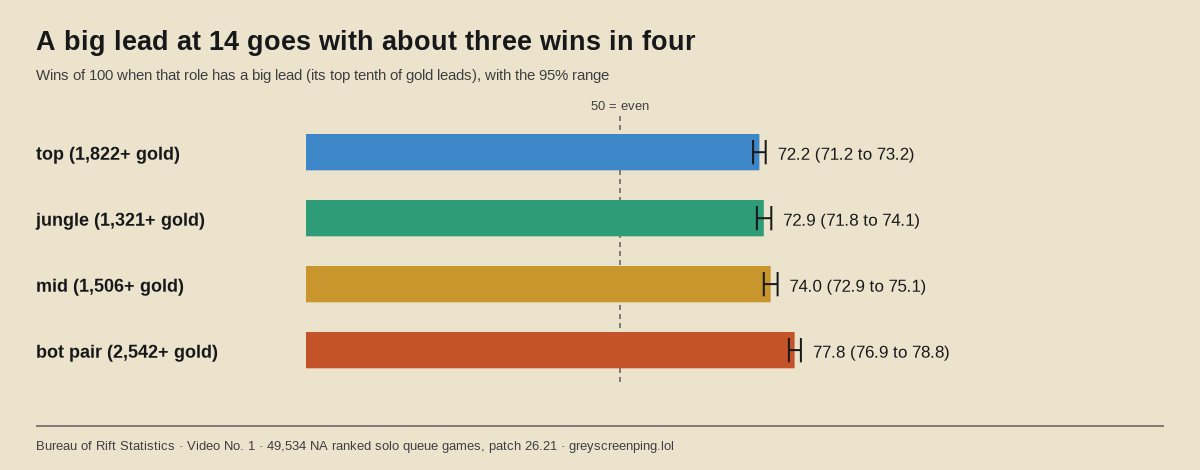
The numbers as a table
| Role | Wins of 100 with a big lead (95% range) |
|---|---|
| top | 72.2 (71.2 to 73.2) |
| jungle | 72.9 (71.8 to 74.1) |
| mid | 74.0 (72.9 to 75.1) |
| bot pair | 77.8 (76.9 to 78.8) |
Came true on 26.18 to 26.20 On 186,417 more games, a big lead went with 71.2 wins in 100 for top, 72.5 for jungle, 73.7 for mid and 77.8 for the bot pair. The test. Claim trace rows 157 to 161.
One caution, said once and in full. A lead goes with winning. It doesn’t prove the lead did it. The team that gets ahead is often the better team, and they’d have won some of those games without it. These numbers say how often, not why.
I ran the same test with XP instead of gold, with CS, and at minutes 10 and 15. The numbers moved a few points and the order of the roles shuffled, but a big lead still went with winning most games.
| Big lead measured by | top | jungle | mid | bot pair |
|---|---|---|---|---|
| XP | 73.0 | 75.3 | 72.3 | 75.9 |
| CS | 67.2 | 71.5 | 67.0 | 66.5 |
| gold at minute 10 | 68.6 | 68.2 | 69.6 | 72.4 |
| gold at minute 15 | 74.5 | 75.5 | 75.9 | 80.4 |
Claim trace rows 94 to 97.
Mantle
No tipping point
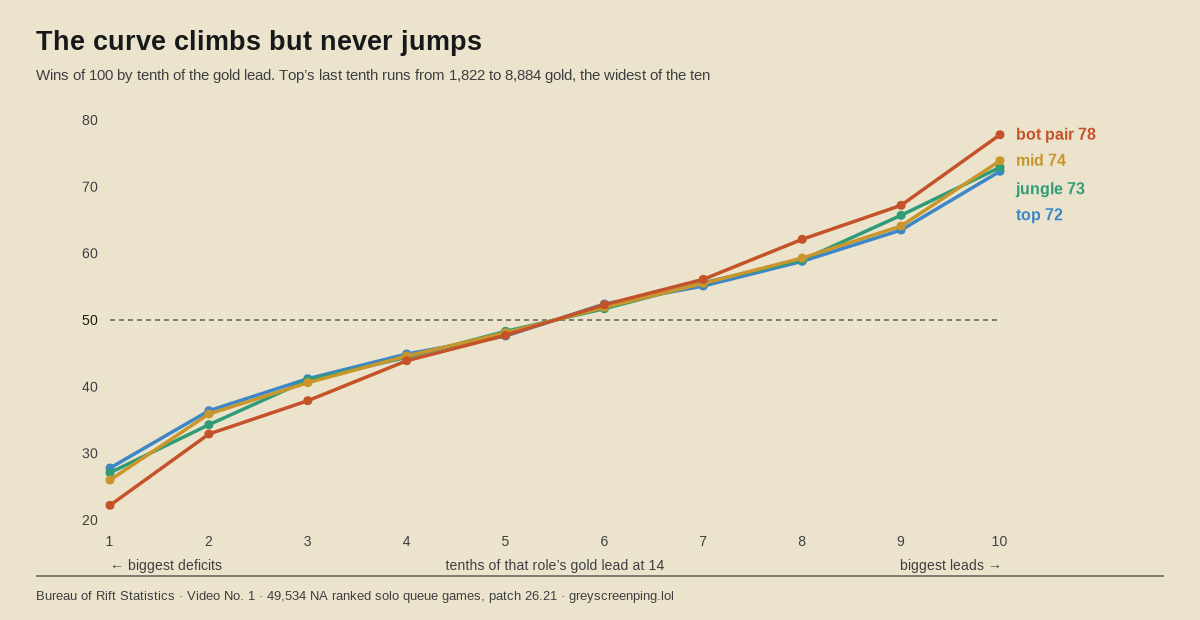
The numbers as a table
| Tenth (1 = biggest deficits) | top | jungle | mid | bot pair |
|---|---|---|---|---|
| 1 | 27.8 | 27.1 | 26.0 | 22.2 |
| 2 | 36.4 | 34.3 | 35.9 | 32.9 |
| 3 | 41.2 | 41.0 | 40.6 | 37.9 |
| 4 | 44.9 | 44.4 | 44.6 | 43.9 |
| 5 | 47.6 | 48.3 | 48.1 | 47.7 |
| 6 | 52.4 | 51.7 | 51.9 | 52.3 |
| 7 | 55.1 | 55.6 | 55.5 | 56.1 |
| 8 | 58.8 | 59.0 | 59.3 | 62.1 |
| 9 | 63.5 | 65.7 | 64.1 | 67.2 |
| 10 | 72.3 | 72.9 | 73.9 | 77.8 |
I went looking for the point where a lead tips over and decides the game. It would look like a cliff. The last step looks the biggest, but the last tenth also covers the widest range of gold, from 1,822 up to 8,884 for top. A small lead leaves the game wide open.
Outer core
One role ahead isn’t a team ahead
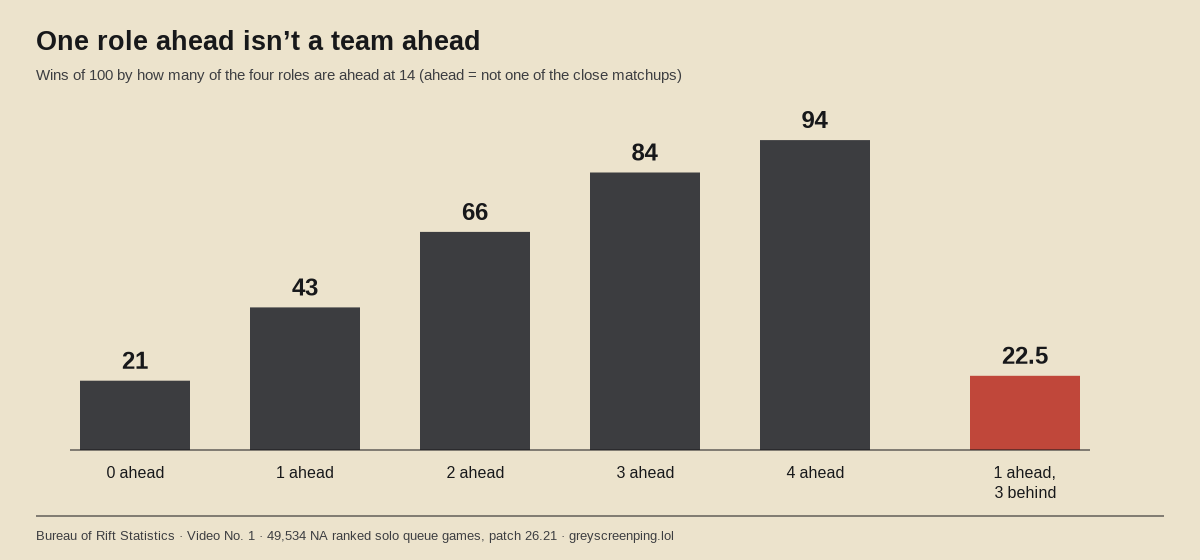
The numbers as a table
| Roles ahead at 14 | Wins of 100 (95% range) |
|---|---|
| 0 | 21.0 (20.4 to 21.7) |
| 1 | 43.2 (42.8 to 43.7) |
| 2 | 66.1 (65.4 to 66.7) |
| 3 | 84.1 (83.2 to 85.0) |
| 4 | 93.9 (92.4 to 95.1) |
| 1 ahead, 3 behind | 22.5 (21.1 to 23.9) |
Came true on 26.18 to 26.20 All four ahead: 95.3. One ahead and three behind: 22.3. The test. Claim trace row 162.
Every number above this one ignored the other roles. Count them, and one lead isn’t much. “I can’t win when three lanes lose,” says Garen, and the data mostly agrees.
Outer core
When they have one too
Before I’d seen any of this, a commenter on the Reddit thread pushed back: when one player is far ahead, the other team often has someone far ahead too, and that pulls things toward fifty-fifty.
By luck alone, their other three roles would give them a big lead of their own about 27 games in 100. They get there less often than that: 20.3 to 22.5 games in 100, depending on whose lead it is. Big leads tend to show up on one side.
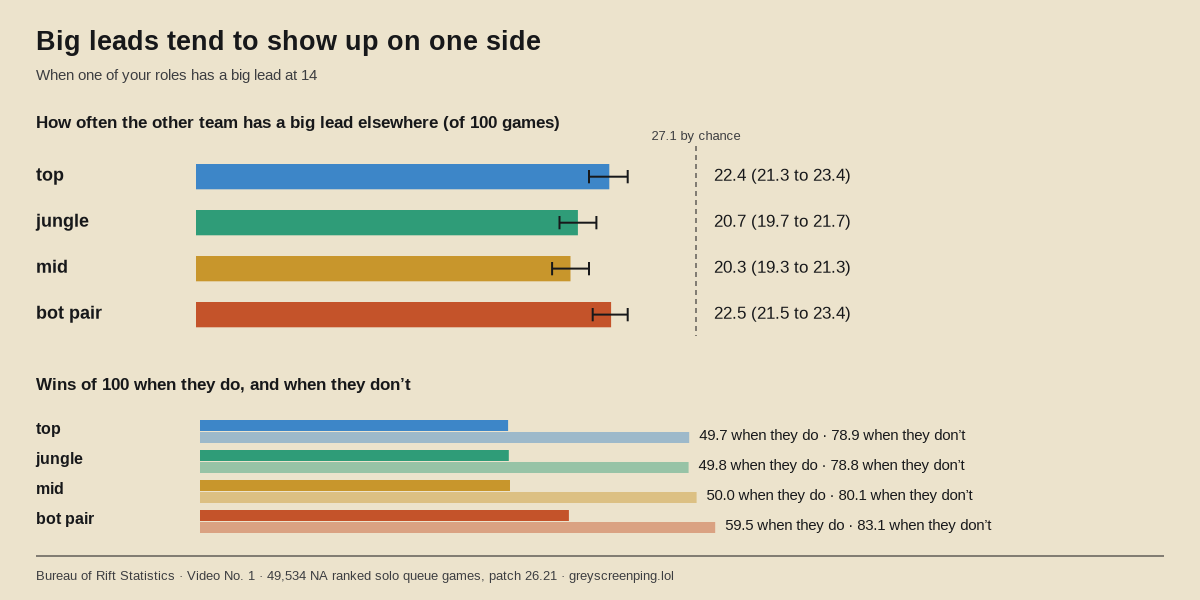
The numbers as a table
| Your big lead in | They have one elsewhere (of 100) | Wins when they do | Wins when they don’t |
|---|---|---|---|
| top | 22.4 (21.3 to 23.4) | 49.7 (47.0 to 52.1) | 78.9 (77.9 to 80.0) |
| jungle | 20.7 (19.7 to 21.7) | 49.8 (47.0 to 52.7) | 78.8 (77.6 to 79.9) |
| mid | 20.3 (19.3 to 21.3) | 50.0 (47.3 to 52.8) | 80.1 (79.0 to 81.2) |
| bot pair | 22.5 (21.5 to 23.4) | 59.5 (57.1 to 61.9) | 83.1 (82.1 to 84.1) |
Came true on 26.18 to 26.20 The other team had a big lead elsewhere 20.8 to 23.6 games in 100, against 27.1 by chance. The test. Claim trace row 163.
So the commenter was right about those games: when one of theirs is fed too, it’s about a coin flip, except when the big lead is your bot pair’s. Thanks, Reddit.
Inner core
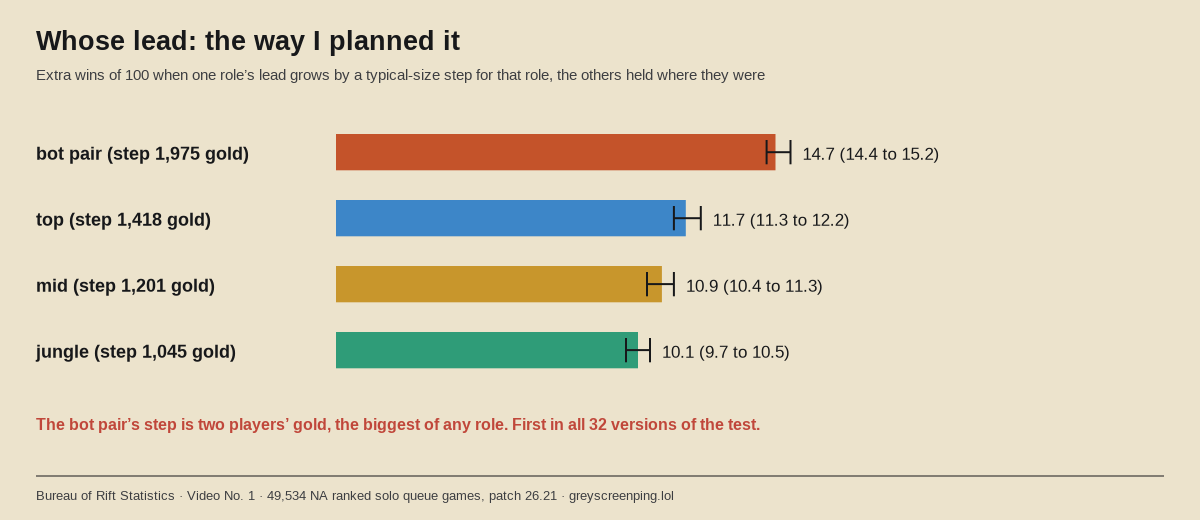
Whose lead: the way I planned it
To compare roles I need one more idea. Take a lead and make it bigger by a step about the size of a typical lead in that role, with every other role left where it was. How many more games in 100 does the team win? Call that extra wins.
The numbers as a table
| Role | Typical step (gold) | Extra wins of 100 (95% range) |
|---|---|---|
| bot pair | 1,975 | 14.7 (14.4 to 15.2) |
| top | 1,418 | 11.7 (11.3 to 12.2) |
| mid | 1,201 | 10.9 (10.4 to 11.3) |
| jungle | 1,045 | 10.1 (9.7 to 10.5) |
Came true on 26.18 to 26.20 The bot pair came first again, in 32 of 32 versions: 14.9 extra wins, 3.6 more than top. The test. Claim trace row 165.
I didn’t want that to rest on one way of counting, because there isn’t one right way. A lead could be gold or XP. Each role could get its own typical step, or the same 1,000 per player. I could account for champions that usually get ahead anyway, or not. The lead could be an exact number or sorted into five sizes. The jungle could be in or out. Five questions with two fair answers each make 32 versions of the same test, and I wrote all of them down before I saw any data. The bot pair came first in all 32.
Then a commenter’s warning came true. Caitlyn and Lux are two players, so in gold their typical step is a step for two players at once: 1,975 gold against 1,045 to 1,418 for the solo roles. The flat-1,000 versions gave the pair 2,000. Most of the 32 gave the pair a bigger push than anyone else. The XP versions with a typical step didn’t, and the pair still came first there too. So the bigger push isn’t the whole story, but it’s enough that I had to ask the question another way.
All 32 versions, extra wins of 100 (top · jungle · mid · bot pair)
| Version | top | jungle | mid | bot pair |
|---|---|---|---|---|
| gold, one typical step (SD), champion's usual lead not counted, exact lead, jungle in | 11.7 (11.3 to 12.2) | 10.1 (9.7 to 10.5) | 10.9 (10.4 to 11.3) | 14.7 (14.4 to 15.2) |
| gold, one typical step (SD), champion's usual lead not counted, exact lead, jungle out | 12.2 (11.8 to 12.6) | · | 12.2 (11.7 to 12.6) | 15.2 (14.8 to 15.6) |
| gold, one typical step (SD), champion's usual lead not counted, five sizes, jungle in | 10.0 (9.5 to 10.4) | 8.9 (8.5 to 9.4) | 9.0 (8.5 to 9.4) | 12.4 (12.0 to 12.9) |
| gold, one typical step (SD), champion's usual lead not counted, five sizes, jungle out | 10.3 (9.9 to 10.8) | · | 10.1 (9.6 to 10.6) | 12.8 (12.4 to 13.3) |
| XP, one typical step (SD), champion's usual lead not counted, exact lead, jungle in | 11.9 (11.5 to 12.3) | 10.1 (9.7 to 10.6) | 10.2 (9.7 to 10.7) | 13.3 (12.9 to 13.7) |
| XP, one typical step (SD), champion's usual lead not counted, exact lead, jungle out | 12.8 (12.4 to 13.2) | · | 11.5 (11.0 to 11.9) | 14.6 (14.1 to 15.0) |
| XP, one typical step (SD), champion's usual lead not counted, five sizes, jungle in | 9.7 (9.3 to 10.1) | 9.0 (8.5 to 9.5) | 8.7 (8.2 to 9.2) | 11.2 (10.8 to 11.7) |
| XP, one typical step (SD), champion's usual lead not counted, five sizes, jungle out | 10.4 (10.0 to 10.8) | · | 9.7 (9.2 to 10.2) | 12.3 (11.9 to 12.8) |
| gold, one typical step (SD), champion's usual lead counted, exact lead, jungle in | 12.4 (12.0 to 12.8) | 10.5 (10.0 to 10.9) | 11.6 (11.1 to 12.0) | 15.4 (15.0 to 15.8) |
| gold, one typical step (SD), champion's usual lead counted, exact lead, jungle out | 12.9 (12.5 to 13.4) | · | 13.0 (12.5 to 13.4) | 15.8 (15.4 to 16.2) |
| gold, one typical step (SD), champion's usual lead counted, five sizes, jungle in | 10.5 (10.0 to 10.9) | 9.2 (8.7 to 9.6) | 9.5 (9.1 to 10.0) | 12.9 (12.5 to 13.4) |
| gold, one typical step (SD), champion's usual lead counted, five sizes, jungle out | 10.9 (10.5 to 11.3) | · | 10.8 (10.3 to 11.2) | 13.4 (12.9 to 13.8) |
| XP, one typical step (SD), champion's usual lead counted, exact lead, jungle in | 12.3 (11.9 to 12.8) | 10.6 (10.1 to 11.0) | 10.3 (9.8 to 10.8) | 13.7 (13.3 to 14.1) |
| XP, one typical step (SD), champion's usual lead counted, exact lead, jungle out | 13.3 (12.9 to 13.7) | · | 11.7 (11.2 to 12.1) | 15.0 (14.6 to 15.4) |
| XP, one typical step (SD), champion's usual lead counted, five sizes, jungle in | 10.1 (9.6 to 10.5) | 9.4 (8.9 to 9.8) | 8.8 (8.3 to 9.3) | 11.5 (11.1 to 12.0) |
| XP, one typical step (SD), champion's usual lead counted, five sizes, jungle out | 10.8 (10.4 to 11.3) | · | 9.9 (9.4 to 10.4) | 12.7 (12.2 to 13.2) |
| gold, a flat 1,000 per player, champion's usual lead not counted, exact lead, jungle in | 8.3 (8.0 to 8.6) | 9.7 (9.3 to 10.1) | 9.1 (8.7 to 9.4) | 14.9 (14.5 to 15.3) |
| gold, a flat 1,000 per player, champion's usual lead not counted, exact lead, jungle out | 8.7 (8.4 to 9.0) | · | 10.2 (9.8 to 10.5) | 15.3 (14.9 to 15.8) |
| gold, a flat 1,000 per player, champion's usual lead not counted, five sizes, jungle in | 7.3 (7.0 to 7.6) | 8.6 (8.2 to 9.0) | 7.8 (7.4 to 8.2) | 12.5 (12.1 to 13.0) |
| gold, a flat 1,000 per player, champion's usual lead not counted, five sizes, jungle out | 7.6 (7.3 to 7.9) | · | 8.8 (8.4 to 9.2) | 12.9 (12.5 to 13.4) |
| XP, a flat 1,000 per player, champion's usual lead not counted, exact lead, jungle in | 7.1 (6.8 to 7.3) | 11.1 (10.6 to 11.6) | 9.4 (9.0 to 9.9) | 22.3 (21.7 to 23.0) |
| XP, a flat 1,000 per player, champion's usual lead not counted, exact lead, jungle out | 7.7 (7.4 to 7.9) | · | 10.6 (10.2 to 11.0) | 24.3 (23.6 to 24.9) |
| XP, a flat 1,000 per player, champion's usual lead not counted, five sizes, jungle in | 6.1 (5.8 to 6.3) | 9.7 (9.2 to 10.2) | 8.1 (7.6 to 8.6) | 16.2 (15.5 to 16.9) |
| XP, a flat 1,000 per player, champion's usual lead not counted, five sizes, jungle out | 6.5 (6.3 to 6.8) | · | 9.1 (8.6 to 9.5) | 17.8 (17.1 to 18.5) |
| gold, a flat 1,000 per player, champion's usual lead counted, exact lead, jungle in | 8.8 (8.5 to 9.1) | 10.0 (9.6 to 10.4) | 9.7 (9.3 to 10.0) | 15.5 (15.2 to 15.9) |
| gold, a flat 1,000 per player, champion's usual lead counted, exact lead, jungle out | 9.2 (8.9 to 9.5) | · | 10.9 (10.5 to 11.2) | 16.0 (15.6 to 16.4) |
| gold, a flat 1,000 per player, champion's usual lead counted, five sizes, jungle in | 7.7 (7.4 to 8.0) | 8.9 (8.4 to 9.3) | 8.3 (7.8 to 8.7) | 13.0 (12.6 to 13.5) |
| gold, a flat 1,000 per player, champion's usual lead counted, five sizes, jungle out | 8.1 (7.8 to 8.4) | · | 9.3 (8.9 to 9.7) | 13.5 (13.1 to 14.0) |
| XP, a flat 1,000 per player, champion's usual lead counted, exact lead, jungle in | 7.4 (7.1 to 7.6) | 11.6 (11.1 to 12.0) | 9.6 (9.1 to 10.0) | 23.0 (22.3 to 23.6) |
| XP, a flat 1,000 per player, champion's usual lead counted, exact lead, jungle out | 8.0 (7.7 to 8.2) | · | 10.8 (10.3 to 11.2) | 25.0 (24.3 to 25.6) |
| XP, a flat 1,000 per player, champion's usual lead counted, five sizes, jungle in | 6.3 (6.1 to 6.5) | 10.1 (9.5 to 10.6) | 8.2 (7.7 to 8.7) | 16.6 (15.9 to 17.4) |
| XP, a flat 1,000 per player, champion's usual lead counted, five sizes, jungle out | 6.8 (6.6 to 7.0) | · | 9.2 (8.8 to 9.7) | 18.3 (17.6 to 19.0) |
· means the jungle was left out of that version. Claim trace rows 113 to 144; first counts in row 56; steps in row 111.
Inner core
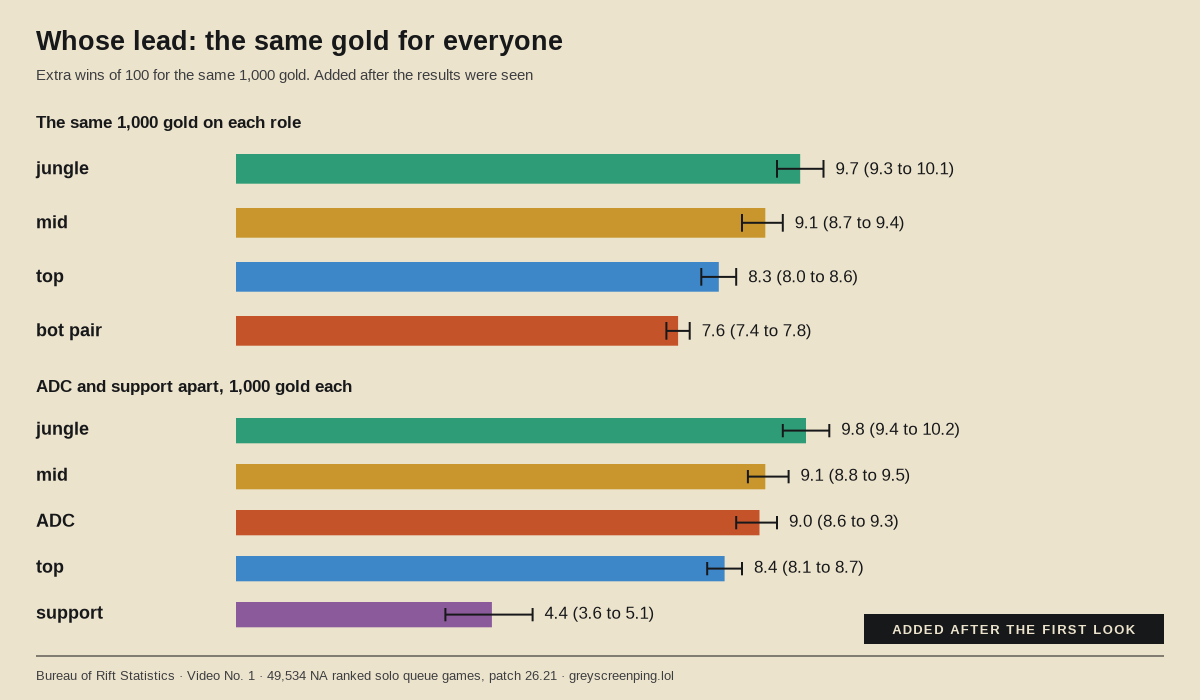
Whose lead: the same gold for everyone
Added after the results were seen
I asked it another way. Every role gets the same 1,000 gold, about what three kills pay before 14.
The numbers as a table
| Role | Extra wins for the same 1,000 gold (95% range) |
|---|---|
| jungle | 9.7 (9.3 to 10.1) |
| mid | 9.1 (8.7 to 9.4) |
| top | 8.3 (8.0 to 8.6) |
| bot pair | 7.6 (7.4 to 7.8) |
| jungle (ADC and support apart) | 9.8 (9.4 to 10.2) |
| mid (ADC and support apart) | 9.1 (8.8 to 9.5) |
| ADC (ADC and support apart) | 9.0 (8.6 to 9.3) |
| top (ADC and support apart) | 8.4 (8.1 to 8.7) |
| support (ADC and support apart) | 4.4 (3.6 to 5.1) |
Came true on 26.18 to 26.20 It showed up again on games I hadn’t looked at: jungle 9.5, mid 9.1, top 8.1, bot pair 7.7. Apart, ADC 9.1 and support 4.2. The test. Claim trace rows 166, 167.
I redrew the players at random 1,000 times and reran it. The bot pair came last every time. That rules out noise in the sample. It doesn’t change that I picked this check after looking.
A support main on the thread said gold is the wrong ruler for supports, and others asked to see the support on its own. So I split the pair, also after I’d seen the results. 1,000 gold on the ADC goes with about what it does on mid. On the support, about half that.
Planned before the results
That doesn’t mean supports matter less. A support with a big lead of their own (942+ gold) still goes with 70 wins in 100, partly because a support that far up usually means the whole bot lane is going well: ADC and support are ahead together in 69 games in 100. For a support, 1,000 gold is already a big lead, so take that half as a rate, not a game you’ll see often.
There are two answers, and both are true. If you’re asking whose lead you want, it’s the bot pair, two players measured together. If you’re asking where the same gold goes with the most, it’s your jungler, just ahead of mid.
Mantle, far side
Find your rank, and the rest
Find your rank
Wins of 100 with a big lead at 14, by role and rank group, on patch 26.21.
| Role | Iron to Silver | Gold to Emerald | Diamond and up |
|---|---|---|---|
| top | 73.7 (72.3 to 75.1) | 71.6 (70.0 to 73.0) | 69.6 (68.2 to 71.0) |
| jungle | 73.8 (72.2 to 75.4) | 72.0 (70.3 to 73.8) | 74.3 (73.1 to 75.6) |
| mid | 72.9 (71.4 to 74.4) | 74.6 (73.1 to 76.3) | 74.8 (73.2 to 76.3) |
| bot pair | 78.4 (76.9 to 79.8) | 77.5 (76.0 to 79.0) | 77.3 (75.9 to 78.7) |
Claim trace rows 33 to 36.
The same on three earlier patches, 26.18 to 26.20:
| Role | Iron to Silver | Gold to Emerald | Diamond and up |
|---|---|---|---|
| top | 72.1 (71.2 to 73.0) | 70.9 (70.0 to 71.7) | 70.0 (69.2 to 70.8) |
| jungle | 72.4 (71.5 to 73.3) | 72.3 (71.5 to 73.0) | 74.1 (73.4 to 74.9) |
| mid | 73.9 (73.1 to 74.8) | 73.4 (72.5 to 74.1) | 75.4 (74.7 to 76.1) |
| bot pair | 78.6 (77.7 to 79.4) | 77.3 (76.5 to 78.2) | 78.1 (77.4 to 78.7) |
Claim trace rows 169 to 172.
On patch 26.21, a big top lead goes with a few fewer wins higher up, maybe because people there are better at taking it back, and no other role showed that slope. Both were predictions (P8a and P8b below). On the earlier patches, top’s drop showed again (72.1 down to 70.0). Jungle’s flat line didn’t: there, a jungler’s big lead goes with more wins in Diamond and up (74.1) than in Iron to Silver (72.4). Mid rose the same way (73.9 to 75.4), though mid wasn’t one of the predictions.
Is the rest of the team ahead too?
The easy test says yes, but a role’s gold is part of the team’s gold, so that test grades itself. Take the role out, and the other four are ahead at 20, or have already won, a little better than half the time. That’s what you’d see if the lead helped the others. It’s also what you’d see if the team was better in every role, so this count can’t tell those apart.
| Ahead at 14 | Team ahead at 20, or won | The other four ahead at 20, or won |
|---|---|---|
| top | 69.6 (69.0 to 70.2) | 53.0 (52.3 to 53.5) |
| jungle | 68.2 (67.6 to 68.7) | 56.5 (55.9 to 57.1) |
| mid | 69.7 (69.0 to 70.2) | 56.0 (55.3 to 56.6) |
| bot pair | 73.1 (72.6 to 73.7) | 52.3 (51.7 to 53.0) |
Claim trace rows 82 to 89.
Came true on 26.18 to 26.20 The other four ahead at 20, or won: top 52.4, jungle 56.5, mid 56.4, bot pair 52.3. The test. Claim trace row 174.
“My champ scales”
In mid and bot, I can’t tell late-game champions that fell behind from early-game champions that fell behind. In top, the late-game ones did a tiny bit better from behind, small enough that it could be chance. Which champions count as late-game came from how their win rate changes as games run longer, so this describes a pattern. It doesn’t test one.
| Role and side | Late minus early, wins of 100; reading |
|---|---|
| top, leading champion | 1.8 (0.1 to 3.5); late higher |
| top, behind side | 1.7 (0.1 to 3.3); late higher |
| mid, leading champion | -0.6 (-2.5 to 1.4); no clear difference |
| mid, behind side | -0.2 (-1.9 to 1.4); no clear difference |
| bot pair, leading champion | 1.0 (-0.7 to 2.8); no clear difference |
| bot pair, behind side | -1.5 (-3.3 to 0.4); no clear difference |
Claim trace rows 76 to 81.
Crust, far side
The limits
- Cause. The team that gets ahead is often the better team. Everything here is how often, not why.
- One region. North America, patch 26.21, checked against three earlier patches (186,417 more games): 12 of 13 predictions came true. The one that didn’t is in band 12.
- Players repeat. The same players show up in many games. The ranges allow for it: they come from redrawing players at random 1,000 times.
- Minute 14 is one choice. Minutes 10 and 15, XP and CS are in band 3.
- Looked first, tested second. The same-gold check and the ADC and support split came after I’d seen the results, and they’re stamped. If you look first and test second, you can fool yourself.
- Not measured. Objectives after a lead, and pro play.
- The guess chart. I planned to chart the thread’s guesses against the result. Four guesses came in against a minimum of 30, so I dropped it.
Crust, far side
The Bureau’s verdict
In the matter of the Lead at Fourteen. Four charges, North America, ranked solo queue, patch 26.21, with 12 of 13 predictions holding on three earlier patches.
- Charge 1, a big lead wins the game: guilty in part. A big lead in any role goes with about three wins in four (72 to 78 in 100). It’s a good lead, not a won game.
- Charge 2, one lane can win it alone: not guilty. One role ahead with three behind goes with 22.5 wins in 100.
- Charge 3, one role’s lead is worth the most: split verdict. By the rule written down first, the bot pair: a lead in bot went with the biggest difference, on four patches, first in 32 of 32 versions each time, measured as two players together. For the same 1,000 gold, found after the first look and seen again on three earlier patches: your jungler, just ahead of mid, with the bot pair last.
- Charge 4, my champ scales, so losing lane is fine: no clear evidence either way.
Sentencing recommendations, for the rest of us:
- Three kills up at 14: you’re ahead, not done. Check the other three roles before you type.
- Arguing about whose lead matters: say whether you mean the role or the gold.
Far surface
The predictions
Before opening a single minute of data from three earlier patches (26.18 to 26.20), I wrote down 13 predictions and what would count as each one coming true. I locked them on 19 November 2026 (plan md5 f8f2c40f), and none gets reworded after the numbers come in. Each one reads confirmed or not confirmed, with both patches’ numbers side by side. 12 of 13 were confirmed.
The table is copied from the locked plan, word for word. In it, Census 3 means patch 26.21 and Census 2 means patches 26.18 to 26.20; deviations 9 and 10 are the checks added after the first look.
| # | Status | Prediction | Patch 26.21 | Confirmed on 26.18 to 26.20 if | Patches 26.18 to 26.20 |
|---|---|---|---|---|---|
| P1 | confirmed | A big lead wins about three games in four | top 72.2 (71.2 to 73.2); jungle 72.9 (71.8 to 74.1); mid 74.0 (72.9 to 75.1); bot pair 77.8 (76.9 to 78.8) | each role's figure is within 3 points of its Census 3 figure | top 71.2 (70.6 to 71.8); jungle 72.5 (72.0 to 73.1); mid 73.7 (73.2 to 74.3); bot pair 77.8 (77.3 to 78.4) |
| P2 | confirmed | Bot's big lead wins most | bot above the others by 3.9 to 5.6 points | bot's range is wholly above each other role's point estimate | bot pair 77.8 (77.3 to 78.4); top 71.2, jungle 72.5, mid 73.7 |
| P3 | confirmed | More roles ahead, more wins; one ahead and three behind mostly loses | 21, 43, 66, 84, 94; one against three 22.5 (21.1 to 23.9) | the five figures rise in order, and one-against-three has its whole range under 30 | 21.5, 43.3, 65.5, 83.8, 95.3; one against three 22.3 (21.5 to 23.1) |
| P4 | confirmed | The enemy rarely has a big lead elsewhere | top 22.4 (21.3 to 23.4); jungle 20.7 (19.7 to 21.7); mid 20.3 (19.3 to 21.3); bot pair 22.5 (21.5 to 23.4); chance is 27.1 | every role's range is wholly under 27.1 | top 23.3 (22.7 to 23.9); jungle 21.1 (20.6 to 21.7); mid 20.8 (20.3 to 21.3); bot pair 23.6 (23.1 to 24.2); chance is 27.1 |
| P5 | confirmed | Pre-registered claim: a typical bot lead goes with the biggest difference | per SD: top 11.7 (11.3 to 12.2); jungle 10.1 (9.7 to 10.5); mid 10.9 (10.4 to 11.3); bot pair 14.7 (14.4 to 15.2); bot first in 32 of 32 | the locked rule names bot again (first in at least 90% of the specifications that include it, and the primary first-minus-second range above 0) | per SD: top 11.3 (11.1 to 11.6); jungle 9.9 (9.7 to 10.1); mid 11.0 (10.7 to 11.2); bot pair 14.9 (14.7 to 15.1); bot first in 32 of 32; first minus second 3.6 (3.2 to 3.9) |
| P6 | confirmed | Deviation 9: the same 1,000 total gold is worth least in bot | jungle 9.7 (9.3 to 10.1); mid 9.1 (8.7 to 9.4); top 8.3 (8.0 to 8.6); bot pair 7.6 (7.4 to 7.8) | bot is last and each solo-role-minus-bot range is above 0 | jungle 9.5 (9.3 to 9.7); mid 9.1 (8.9 to 9.3); top 8.1 (7.9 to 8.3); bot pair 7.7 (7.6 to 7.8) |
| P7a | confirmed | Deviation 10: support gold is worth about half | jungle 9.8 (9.4 to 10.2); mid 9.1 (8.8 to 9.5); ADC 9.0 (8.6 to 9.3); top 8.4 (8.1 to 8.7); support 4.4 (3.6 to 5.1) | support is last, the ADC-minus-support range is above 0, and support's figure is between 35% and 65% of the ADC's | jungle 9.6 (9.4 to 9.8); mid 9.2 (9.0 to 9.4); ADC 9.1 (8.9 to 9.3); top 8.2 (8.0 to 8.3); support 4.2 (3.9 to 4.6); ADC minus support 4.9 (4.4 to 5.4) |
| P7b | confirmed | Deviation 10: ADC gold is worth about what mid gold is | mid minus ADC 0.2 (-0.4 to 0.7) | the mid-minus-ADC range includes 0, or the two point estimates are within 1 point | mid minus ADC 0.1 (-0.2 to 0.4) |
| P7c | confirmed | Deviation 10: jungle gold is worth most | jungle first in 982 of 1,000 replicates | jungle has the highest point estimate and its range over top is above 0 (jungle against mid is too close to predict) | jungle first in 995 of 1,000 replicates; jungle minus top 1.5 (1.2 to 1.8) |
| P8a | confirmed | Top's big lead is worth less at higher rank | 73.7 (72.3 to 75.1), 71.6 (70.0 to 73.0), 69.6 (68.2 to 71.0) from low to high | Iron to Silver is above Diamond and up with ranges that do not overlap | 72.1 (71.2 to 73.0), 70.9 (70.0 to 71.7), 70.0 (69.2 to 70.8) from low to high |
| P8b | not confirmed | Jungle's shows no rank trend | 73.8 (72.2 to 75.4), 72.0 (70.3 to 73.8), 74.3 (73.1 to 75.6) | the lowest and highest rank groups' ranges overlap | 72.4 (71.5 to 73.3), 72.3 (71.5 to 73.0), 74.1 (73.4 to 74.9) from low to high |
| P9 | confirmed | ADC and support leads only partly move together | correlation 0.53; ADC alone 76.7 (75.8 to 77.7), support alone 70.4 (69.3 to 71.5) | the correlation is between 0.40 and 0.65, and the ADC's big-lead figure is above the support's with ranges that do not overlap | correlation 0.53; ADC alone 77.0 (76.4 to 77.5), support alone 70.1 (69.5 to 70.7) |
| P10 | confirmed | With a role ahead, the rest of the team is ahead a little more than half the time at 20 | top 53.0 (52.3 to 53.5); jungle 56.5 (55.9 to 57.1); mid 56.0 (55.3 to 56.6); bot pair 52.3 (51.7 to 53.0) | every role's range is above 50 and under 60 | top 52.4 (52.0 to 52.7); jungle 56.5 (56.1 to 56.8); mid 56.4 (56.1 to 56.8); bot pair 52.3 (51.9 to 52.6) |
Follow-ups
The results go here first, dated, and then get announced.
23 November 2026: the earlier patches. 186,417 more games from patches 26.18 to 26.20, run with the same code and the same plan, both checked by hash before the run. 12 of the 13 predictions came true. The one that didn’t is P8b, jungle’s big lead showing no rank trend: on the earlier patches, a jungler’s big lead goes with more wins in Diamond and up (74.1) than in Iron to Silver (72.4), and the two ranges don’t touch. Patch 26.21 changed the jungle, which could explain the difference. It doesn’t rescue the prediction. How the run went, with its hashes, is on the method page.
Claim trace rows 157 to 175.
Far surface
Tell the Bureau
What should go on trial next? Tell me under the video or in the common room. One idea from the thread is already on the list: what a lead at 14 goes with in objectives, from towers to dragons.
And if I got something wrong, the corrections page is where it gets fixed, in public.
Read the script
Cold open
It's fourteen minutes in. Your Garen is three or four kills up on their Darius, forty CS ahead, and already typing in all chat.
Out of a hundred games that look like this one, how many do you win? Lock in a number, do it right now.
I asked a League subreddit something close to this. The few who answered said a bit better than a coin flip.
It's seventy-two games.
That Garen still loses twenty-eight of them, and you and I have certainly been there.
But then I asked which role you'd want that lead in. I checked the answer every way I could think of, and it came out the same every time. It turned out to be answering a different question than I thought, and the reason is on this scoreboard right now.
I'm Kaosi. I'm a double major at the University of North Texas, in information science and in game studies and design. One is about keeping track of what you know and how you know it. The other is about why games are built the way they are. This video pretty much needed both. I also have spent years on the ranked ladder, and I will not tell you how I did. Yes, I am done. These days I play TFT, which is a much lonelier way to lose.
This isn't a guide to winning lane. It's about what a lead is worth once you have one, and that's what's on trial today.
What a lead is
Let's start with what I'm counting. Garen's gold, minus Darius's gold, averaged over minutes twelve to fourteen. That gap is the lead. Garen stands in for every top laner in these games, whatever they played, and the same goes for the rest of this scoreboard.
Bot lane is two against two, so Caitlyn and Lux go in as one pair, and their gold is added together. Keep an eye on that pair. It matters later.
Why fourteen? Well, that's the earliest objective bounties can switch on, so it's the last minute before they can start paying the team that's behind.
Now line up every top lane in the sample, from the most lopsided one way to the most lopsided the other. Take the top tenth: a lead your top laner has about one game in ten. That's what I'll call a big lead. For a top laner, that starts just around eighteen hundred gold.
Each role gets its own top tenth, so each has its own cut. Jungle leads run smaller and bot leads run bigger, since bot is two players. They're all on the board.
The headline
Give each of your roles a big lead, one at a time.
Top, jungle, mid: with a big lead, each team wins about three games in four. The bot pair, a little more.
One caution, said once and in full. A lead goes with winning. It doesn't prove the lead did it. The team that gets ahead is often the better team, and they'd have won some of those games without it. This is how often, not why.
I ran the test again with XP instead of gold, with CS, at ten minutes and at fifteen. The numbers moved a few points, and the order of the roles shuffled, but a big lead still went with winning most games.
A big gold lead, in any role, goes with about three wins in four.
Size
But how big is big enough? Take Garen just a couple hundred gold up. That's fifty-two wins in a hundred.
He's typing "jungle diff" anyway. It's a coin flip, Garen, just like the ranked ladder promises.
Past eighteen hundred gold, it's the seventy-two wins from before, and in between, each step up adds a few wins. I went looking for the point where a lead tips over and decides the game. It would look like a cliff on this graph. The last step is the biggest, but that last tenth also covers the widest range of gold, from eighteen hundred up to the most lopsided games. There's no single point where the game flips.
A small lead leaves the game wide open, and the curve climbs but never jumps.
One lane against the rest
Now, take a look at the whole team. "Ahead" here is a lower bar than a big lead: it just means the lane isn't one of the close ones. If all four of your roles are ahead at fourteen minutes, you win ninety-four games in a hundred.
And on the other end, one role ahead and the other three behind. Count every game like that, whichever role it was, and the team wins just twenty-two in a hundred. Every number before this one ignored the other roles. Count them, and one lead isn't much.
"I can't win when three lanes lose," and yeah, Garen, the data mostly agrees.
One winning lane is not a winning team.
The commenter's objection
So, hold up. Before I'd seen any of this, a commenter on the Reddit thread pushed back on the question. Their point: when one player is far ahead, the other team often has someone far ahead too, and that pulls things toward fifty-fifty.
Quick guess. But first, the luck version. Their other three roles each have a one-in-ten shot at a big lead of their own. Not Darius. He's the one Garen is ahead of. Three tries at a ten percent drop: you'd hit about one time in four.
So when your Garen has a big lead, does their team have one too, more often than one game in four, or less?
Less. A bit over one game in five. Their Kayn, Yasuo or bot pair gets there less often than luck alone would give.
But they're right about those games. When one of theirs has a big lead too, say their Kayn, it's about a coin flip.
Big leads tend to show up on one side. When they don't, it's close to fifty-fifty, just like the Redditor said. Thank you, Reddit.
Chapter break
Well, that's the first half of the video, and before the second, I'd like you to pick one. Garen, Master Yi, Ahri, or the bot pair. Whose lead do you want in your game?
Which role
To compare roles, I need one more idea. Take a lead and make it bigger by one normal step: about the size of a typical lead in that role, with every other role left where it was. How many more games in a hundred does the team win? We'll call that extra wins.
Give the bot pair their normal step, and they get about fifteen extra wins. Your jungler gets about ten. Top and mid are just in between.
Before I looked at any of this, I wrote down a rule for naming a winner. And by that rule, on this patch, it is the bot pair.
Thirty-two for thirty-two
I didn't want that to hang on one way of counting, because there isn't one right way. Should a lead be gold, or XP? Should each role get its own normal step, or the same thousand per player? Should I account for champions that usually get ahead anyway? Should the lead be an exact number, or sorted into five sizes? Should the jungle be in, or out? Each of those has two fair answers. Five questions, two answers each, makes thirty-two versions of the same test, and I wrote all of them down before I saw any data.
If the bot pair only won a few, I'd call it shaky. It won all thirty-two, and I was ready to make this thumbnail.
And then I looked at the chips. A commenter on the thread had warned me about this before I'd seen a single number. Caitlyn and Lux are two players, so in gold, their normal step is a step for two players at once, the biggest of any role. And the flat-thousand versions meant a thousand each, so two thousand for the pair.
Most of the thirty-two gave the pair a bigger push than anyone else. The XP versions with a normal step didn't, and the pair still came first there too. So the bigger push isn't the whole story. But it was enough that I had to ask the question another way.
The same gold for everyone
So let's do it. Let's ask it another way: the same gold for everyone. Every role gets the same thousand gold, about what three kills pay. I added this check after I'd seen the first results, so it's stamped that way on screen.
Put that thousand gold on your jungler, and it goes with the most extra wins. On mid and top, a bit less. On the bot pair, shared between Caitlyn and Lux, the least.
I redrew the players at random a thousand times and reran it. The bot pair came last every time. That rules out noise in the sample. It doesn't change that I picked this check after looking.
So, there are two answers, and both are true. If you're asking whose lead you want, it's the bot pair, two players measured together. If you're asking where the same gold goes with the most, it's your jungler, just ahead of mid.
Caitlyn and Lux, apart
A support main on the thread said gold is the wrong ruler for supports, and others asked to see the support on their own. So I split the pair, again after I'd seen those results.
That thousand gold on the ADC goes with about nine extra wins, same as on mid. On the support, about half that. That fits what the support main said.
It also helps explain why the pair's gold went with less: part of that gold was the support's.
And it doesn't mean that supports matter less. A support with a big lead of their own still goes with seventy wins in a hundred. Partly that's because, as another commenter pointed out, a support that far up usually means the whole bot lane is going well.
For a support, a thousand gold is already a big lead, so take that half as a rate, not a game you'll see often.
Does it spread?
Is the rest of the team ahead too? The easy test says yes. When Garen is ahead at fourteen, his team is ahead at twenty minutes, or has already won, about seven times in ten. But Garen's gold is part of the team's gold, so that test grades itself.
Take Garen out. The other four are ahead at twenty, or already won, a little better than half the time.
That's what you'd see if Garen's lead helped the others. It's also what you'd see if his team was just better in every role, so this count can't tell those apart.
Rank and scaling
And two quick ones. Rank. In Iron to Silver, a big top lead goes with seventy-four wins. In Diamond and up, seventy. Higher up, a top lead goes with a few fewer wins, maybe because people there are better at taking it back. No other role shows that slope. It's one role of four, so it's one of the predictions I'm checking on other patches.
Scaling. "My champ scales, losing lane is fine." In mid and bot, I can't tell late-game champions that fell behind from early-game champions that fell behind. In top, the late-game ones did a tiny bit better from behind, small enough that it could be chance. Which champions count as late-game came from how their win rate changes as games run longer, so this describes the pattern. It doesn't test it.
What I can't tell you yet
There are two limits to my work. One: this is one region, just on one patch, North America 26.21. And two: the same-gold check, and splitting Caitlyn and Lux by gold, came after I'd seen the results. If you look first and test second, you can fool yourself. So I've written down thirteen predictions for three earlier patches, before opening their minute-by-minute data. I'll follow up with which ones survived once that data is finished pulling.
Close
But back to the start. Your Garen, three or four kills up at fourteen. That goes with seventy-two wins in a hundred.
It's a good lead, not a won game. With one role ahead and the other three behind, a team wins far less. And if one of theirs is fed too, it's about a coin flip.
And whose lead do you want? Still two answers. The way I planned it, on this patch, the bot pair. With the same gold for everyone, your jungler.
So next time your Garen is that far up and typing about it, you'll know exactly what it's worth, Mr. Jungler.
What should go on trial next? Tell me in the comments, please subscribe, and thanks for watching. Bye!
Found a mistake? Tell us in the common room. Every correction is listed with its date.